
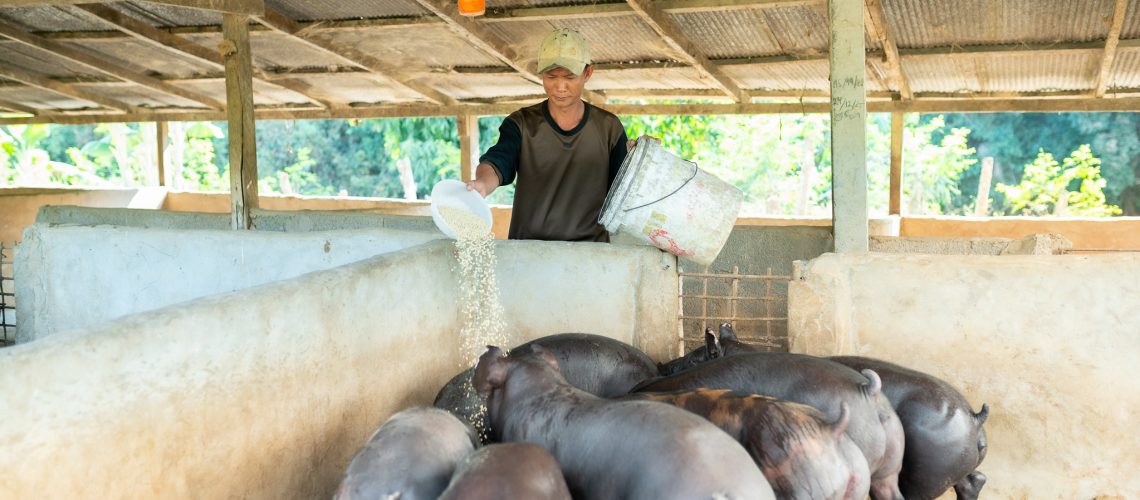
Malnutrition and economic isolation have long posed systemic challenges to ethnic farming communities in the mountainous uplands of Baeng District, Oudomxay Province. However, Phase II of the Agriculture for Nutrition (AFN II) project is rewriting this narrative.
An intensive field-level review managed by CSOs4GAFSP and the Lao Farmers’ Association reveals that localized resource allocation and nutrition-sensitive farming systems are generating impacts that comfortably exceed original project expectations.
Though the comprehensive project lifecycle is only a year and a half into its active timeline, the mid-term data reveals that agricultural yields and average household incomes have already surpassed baseline targets by more than 20%.
This economic surge is driven by localized Agricultural Production Groups (APGs) specializing in high-value, fast-yielding commodities. Cooperative groups focusing on Oyster and Khon Khao mushroom cultivation, safe vegetable farming, and sustainable pig-raising have successfully created reliable, year-round daily cash flows for remote households.
For smallholders like Mr. Somnaen, joining a pig-raising production group transformed his family’s economic security. By integrating preventive vaccinations and local feed-formulation techniques, his group successfully reduced animal mortality and raised high-quality livestock that buyers readily accept, creating a resilient financial safety net.
To systematically eradicate stunting and micro-nutrient deficiencies, the project utilizes a targeted Home Garden Grant (HGG) mechanism. Vulnerable households are equipped with an investment capital kit equivalent to LAK 2,646,145 (US$120) to establish climate-adapted homestead plots, shade houses, and small livestock areas.
This ensures that remote families maintain direct, continuous access to fresh vegetables, proteins, and iron-rich foods during lean seasons, insulating them from food price spikes and expanding dietary diversity among children.
True sustainability requires community ownership, which the project achieves via highly visual, participatory tools. Separate focus groups of men and women utilize interactive “Nutrition Maps” and “Seasonal Calendars” to visually track household food security and labor spikes. Villages then collectively vote on local infrastructure priorities, integrating grassroots needs directly into official local development plans. This systemic change is spearheaded by women, who comprise 75% of the appointed village nutrition facilitators.
Watch the other videos here: https://youtu.be/TdGPPzd37GI, https://youtu.be/GF6qG03Yq1A, https://youtu.be/m3r0v4lfNkI

